Brain Training
Brain training is a billion-dollar promise: play the right games for ten minutes a day and become smarter, sharper, more focused. The research record tells a more interesting story — one with a $50 million court judgment, an 11,430-person experiment, and a surprisingly practical answer about what actually keeps a mind sharp. This guide lays out what brain training is, what the evidence really shows, and how to train your brain in ways that hold up.
What Is Brain Training?
Brain training means structured mental exercise — short, repeatable tasks designed to work specific cognitive abilities such as working memory, processing speed, attention and reasoning. In practice the term covers three quite different things:
- Commercial training apps (Lumosity, Peak, Elevate, NeuroNation, CogniFit) that package cognitive psychology tasks as daily mini-game programs with scores and streaks.
- Classic cognitive tasks straight from the lab — the dual n-back, digit span, reaction-time and sequence-memory tests — which you can run free in a browser.
- Demanding real-world mental activities: learning a language, a musical instrument, or a mind sport such as chess, go or bridge.
The crucial question is not whether these activities make you better at something — they all do — but whether the improvement transfers beyond the trained task. That distinction decides whether brain training “works”.
Does Brain Training Actually Work? What the Evidence Shows
Here is the research consensus in one sentence: practicing a cognitive task reliably makes you better at that task and close variants of it, while evidence that the gains transfer to general intelligence or everyday cognition remains weak. Psychologists call this the difference between near transfer (real, well-documented) and far transfer (largely unsupported).
Three landmark results define the field:
The ACTIVE Trial: Real but Narrow Gains
The ACTIVE study (Advanced Cognitive Training for Independent and Vital Elderly) randomized 2,832 older adults into memory, reasoning or processing-speed training. Each group improved on the ability it trained — and some of those specific gains were still measurable years later. What ACTIVE did not find was broad improvement: memory training helped trained memory tasks, not reasoning; reasoning training helped reasoning, not memory. Training was effective, narrow, and durable — all at once.
Brain Test Britain: 11,430 People, Six Weeks, No Transfer
In 2010, researchers working with the BBC ran one of the largest brain-training experiments ever conducted. More than 11,000 participants trained online several times a week for six weeks. Scores on the trained games improved substantially. Performance on closely related but untrained tasks did not. The paper, published in Nature (Owen et al.), remains the cleanest large-scale demonstration of the transfer problem.
The Dual N-Back Saga
A 2008 PNAS study by Susanne Jaeggi and colleagues reported that training on the dual n-back — a brutal working-memory task — increased fluid intelligence, with bigger gains the longer people trained. It was the result the industry had been waiting for, and it launched a wave of working-memory training products. Then came the replications. Multiple independent attempts and meta-analyses (notably Melby-Lervåg and Hulme’s) found that working-memory training improves working-memory tasks and little else. The dual n-back is still a fascinating, genuinely hard exercise — you can try it here — but the IQ claim did not survive scrutiny.
The Lumosity Case: When Marketing Outran the Science
The gap between evidence and advertising became a legal matter in January 2016, when the U.S. Federal Trade Commission settled deceptive-advertising charges against Lumos Labs, the maker of Lumosity. The FTC’s complaint said the company’s ads claimed training would improve performance at work and school and delay age-related cognitive decline — claims the company could not substantiate. The settlement imposed a $50 million judgment, suspended on payment of $2 million, and required notice to subscribers.
The case did not prove that brain games are useless. It established something narrower and more important: as of the settlement, the flagship company in the industry could not produce evidence for the benefits its own advertising promised. Marketing language across the category has been noticeably more careful ever since.
How Brain Training Is Supposed to Work: Neuroplasticity and Its Limits
The theory behind brain training is sound as far as it goes. Neuroplasticity — the brain’s ability to reorganize in response to demands — is real and operates at every age. Skill learning measurably changes the brain; the classic studies of London taxi drivers’ spatial memory are the famous example.
The catch is specificity. Plasticity strengthens the circuits you actually use, for the patterns you actually practice. A memory-matrix game builds an increasingly refined skill at memorizing grids of tiles — not a general “memory muscle” that lifts everything else. Expertise research (from chess studies onward) points the same way: what experts acquire is an enormous library of domain-specific patterns, not a bigger general-purpose processor. That is why pattern recognition, not raw horsepower, is the engine of skilled performance.
What Actually Holds Up: Five Evidence-Backed Ways to Train Your Brain
If far transfer from mini-games is off the table, what should someone who wants a sharper mind actually do? The boring-but-true list, ranked roughly by strength of evidence:
- Physical exercise. Aerobic fitness is the single best-evidenced intervention for long-term cognitive health — its effects show up in trials where brain games’ don’t.
- Learn demanding real skills. A language, an instrument, or a deep game. The skill is its own reward, the difficulty curve never flattens, and the engagement is sustained for years rather than weeks.
- Sleep. Memory consolidation happens offline; chronic short sleep measurably degrades attention and working memory. (More in our piece on sleep and competitive performance.)
- Social, effortful engagement. Activities combining mental challenge with other people — club bridge is the canonical example — correlate with better cognitive aging in observational studies.
- Targeted practice for specific goals. If you want faster mental arithmetic or better recall of names, train exactly that. Near transfer is the one kind of transfer that reliably works — use it deliberately.
Mind Sports as Brain Training
This site’s honest pitch: if you enjoy cognitive challenge, learn a mind sport instead of grinding abstract mini-games. The transfer question changes completely. Nobody plays go to get better at something else — the game itself is the skill, with a depth that out-lasts any app’s content library. Along the way you get the things training apps simulate: calculation under pressure, long-horizon planning, memory for structures, and an opponent who punishes lazy thinking.
Every discipline here has a complete learning path — rules, strategy and a way to play in your browser:
- Chess — and a playable board against the computer
- Go — with a life-and-death problem trainer
- Draughts — play 8×8 or international 10×10
- Xiangqi — Chinese chess against the engine
- Bridge — with a bidding-judgment trainer
For a daily five-minute habit, the Stones logic puzzle resets every midnight UTC.
Free Brain Tests: Measure Instead of Guessing
Cognitive self-tests won’t make you smarter either — but they are honest about what they are: measurements. Ours run free in the browser, with no account, and show how your score compares against published population data:
- Reaction time — raw processing speed, the classic benchmark
- Sequence memory — how long a pattern you can hold and replay
- Number memory — your digit span, the oldest test in cognitive psychology
- Dual n-back — the working-memory task from the 2008 study, as hard as its reputation
Retest under the same conditions (same time of day, rested) if you want numbers you can compare over time.
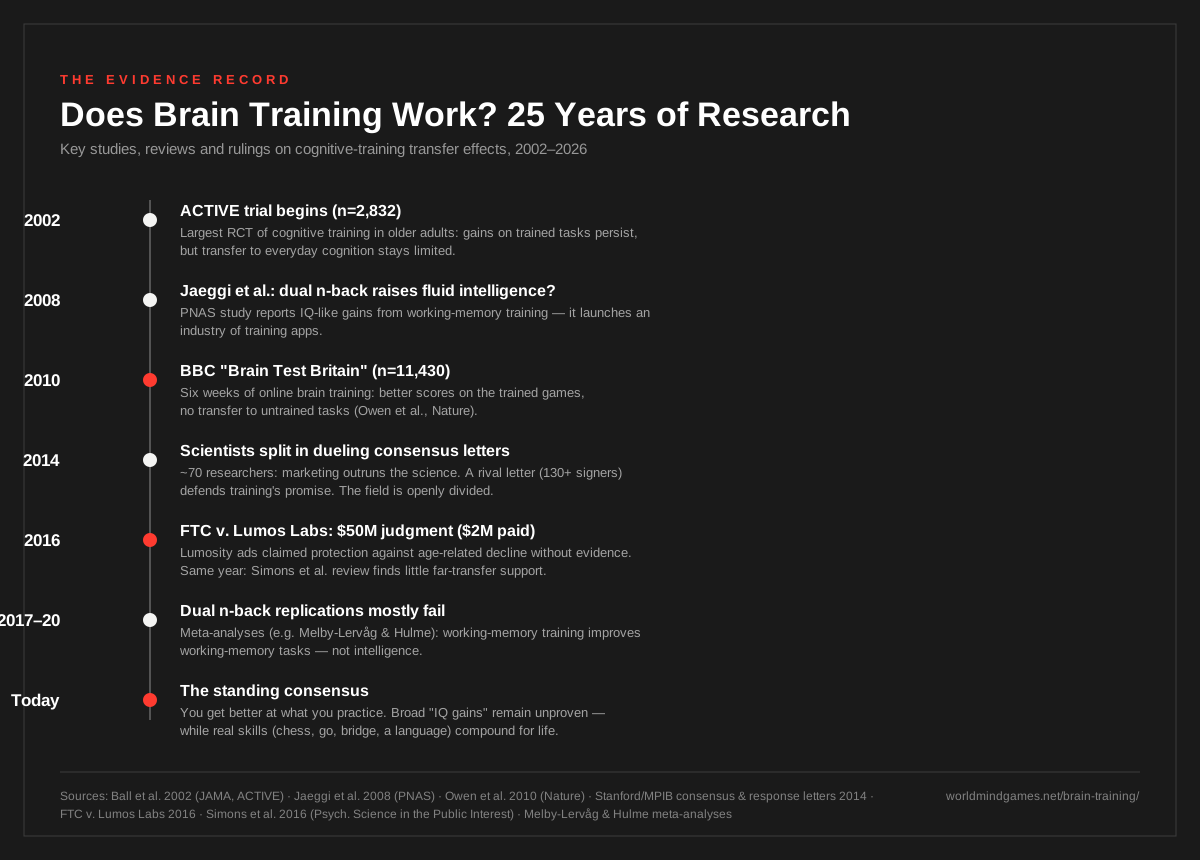
You are welcome to reuse the timeline with attribution. Copy this embed code:
<a href="https://www.worldmindgames.net/brain-training/"><img src="/wp-content/uploads/infographics/brain-training-evidence-timeline.svg" alt="Does brain training work? 25 years of research, visualized" width="1200" height="860"></a> Source: <a href="https://www.worldmindgames.net/brain-training/">World Mind Games</a>
Who Benefits Most from Brain Training?
Three honest answers. People who enjoy it — a cognitive workout you look forward to beats a superior one you abandon; enjoyment is the strongest predictor of sticking with any program. Older adults choosing engagement over passivity — the realistic comparison isn’t brain games versus learning Mandarin, it’s brain games versus television, and against that baseline structured challenge plus the social side of game play looks genuinely worthwhile. Anyone with a specific, trainable goal — near transfer means targeted practice on the exact skill you need does work.
Who should skip it: anyone buying a subscription to “prevent cognitive decline”. That specific promise is the one the evidence — and the FTC — rejected.
How to Build a Brain Routine That Sticks
- Anchor it to a daily ritual. One daily puzzle at the same time each day builds the habit loop; streaks do the motivational work.
- Pick one deep skill for the long arc. Choose a discipline from the seven and commit for a season. Follow the strategy guide, play regularly, review your losses.
- Benchmark quarterly, not daily. Run the test suite every few months under consistent conditions. Day-to-day score-chasing measures noise.
- Protect sleep and movement. The unglamorous foundations carry more evidence than everything above combined.
Does brain training actually work?
It depends what “work” means. Training reliably improves performance on the trained tasks and close variants (near transfer). Evidence that it raises general intelligence or protects against cognitive decline (far transfer) is weak — that’s the consensus from the largest trials and reviews.
What is brain training, exactly?
Structured, repeatable mental exercise targeting specific abilities — working memory, processing speed, attention. It spans commercial apps, classic lab tasks like the dual n-back, and demanding real-world skills such as chess or a new language.
How does brain training work in the brain?
Through neuroplasticity: circuits you use intensively get more efficient at the patterns you practice. The effect is real but specific — it strengthens the trained skill rather than upgrading the brain across the board.
What happened in the Lumosity FTC case?
In January 2016 the FTC settled charges that Lumosity’s ads claimed unproven benefits — better work and school performance, delayed age-related decline. The settlement imposed a $50 million judgment, suspended on payment of $2 million.
Is dual n-back worth doing?
As an IQ-booster, no — the 2008 finding didn’t replicate. As a genuinely hard working-memory exercise and an interesting self-test, yes. You can try it free in your browser here.
What is the most effective brain game?
The one you’ll still be playing in a year. On the evidence, deep games with unlimited skill ceilings — chess, go, bridge — beat rotating mini-games, because sustained engagement is where any benefit lives.
Are there good free brain training options online?
Yes — you don’t need a subscription. Free browser tests (reaction time, memory span, dual n-back) cover the classic tasks, and free mind sports platforms offer effectively infinite structured challenge.
Is brain training good for adults over 60?
Structured mental challenge is reasonable at any age, and the ACTIVE trial showed durable trained-task gains in older adults. The strongest-evidenced habits for cognitive aging remain physical exercise, social engagement and sleep — brain games are a fine supplement, not a substitute.
Can brain training prevent dementia?
No intervention is proven to prevent dementia. Some long-term findings (like ACTIVE’s speed-of-processing follow-ups) are intriguing, but the claim “brain games prevent decline” is exactly the one regulators found unsupported. Be skeptical of anyone selling it.
How often should I do brain exercises?
For habit-building, a short daily session beats occasional marathons. For measurable skills, follow practice principles: regular sessions, increasing difficulty, and review of mistakes — exactly how mind sport players study.
Do chess players have higher IQs?
Strong players tend to score somewhat above average, but expertise research attributes their strength mostly to learned pattern libraries, not raw IQ. Chess skill is built, not bestowed — which is the encouraging version of the answer.
What’s the difference between near and far transfer?
Near transfer: improvement on tasks similar to what you trained — well documented. Far transfer: improvement on dissimilar abilities (training memory to get better at reasoning) — largely unsupported. Most brain-training marketing quietly promises far transfer.
Are puzzle games like sudoku brain training?
They’re mental exercise with the same caveat: you mainly get better at sudoku. As a daily engagement habit they’re excellent — low-friction, genuinely challenging, and free of inflated claims.
How do I measure whether my training works?
Benchmark before you start (reaction time, memory tests), train for a defined period, retest under the same conditions. Expect clear gains on what you practiced and treat anything beyond that as a bonus.
What should I do instead of buying a brain training app?
Pick one deep skill you actually enjoy (a mind sport, an instrument, a language), keep a daily puzzle habit for consistency, exercise, and sleep. That stack covers everything the apps promise — with better evidence.