Play Go Online: Learn the Rules and Train in Your Browser
Liberties, ko and scoring explained, the right board size to start on, and a free tsumego trainer to build your reading — everything needed to start playing go online.
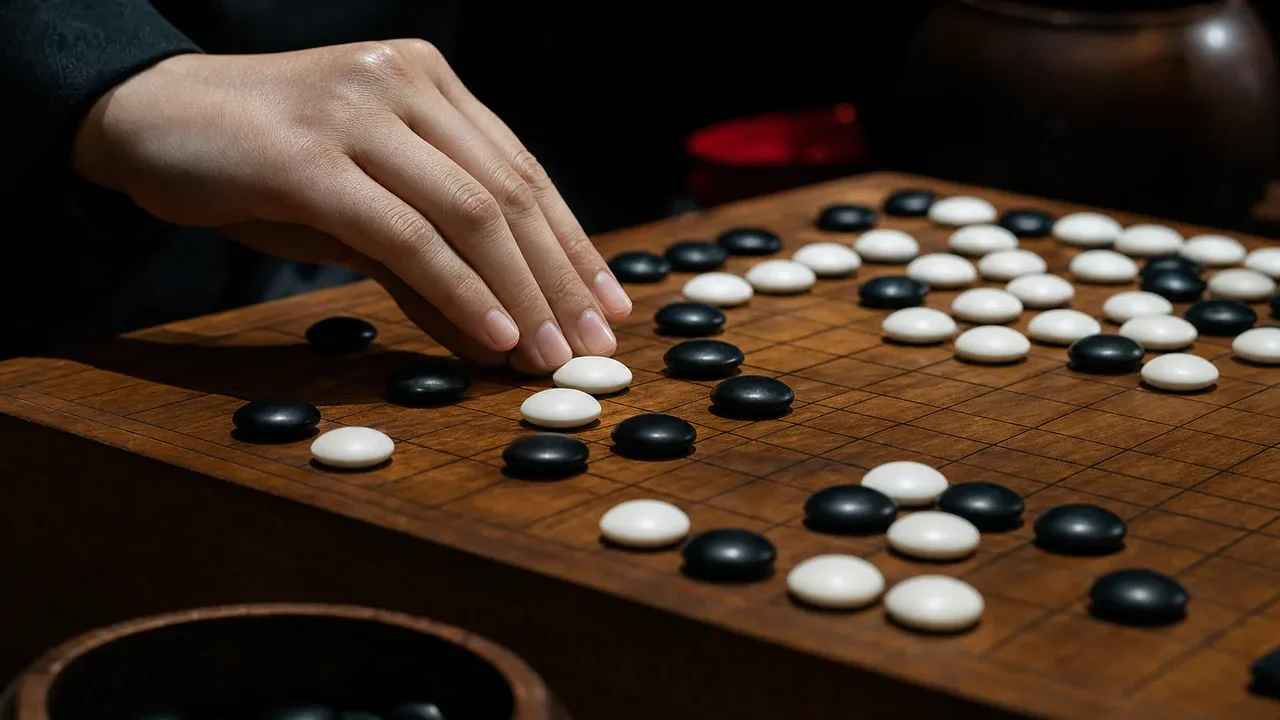
The fastest way to play go online is a board that runs in your browser: no account, no download, just stones on a grid within seconds. This site takes the training-first route – a free go problems trainer with graded life-and-death puzzles – and this guide adds everything around it: the complete rules, how online play is organized, which board size to start on, and the strategy fundamentals that turn your first captures into actual games.
Go deserves the effort. It is the oldest strategy game still played in its original form, its rules fit on an index card, and yet it remained the last classic board game to fall to computers. Whether you arrive from chess, from puzzle apps, or from pure curiosity, the path in is the same: learn liberties, learn ko, and start playing.
Playing Go Online: What Your Options Look Like
Online go comes in three broad formats. Live games pair you with a human opponent in real time, usually with per-move clocks that keep games brisk. Correspondence games stretch over days, one move at a time – ideal alongside a job. Computer opponents and trainers let you practice without scheduling anything; since the deep-learning breakthrough, even browser-strength engines play far above casual human level, and they make patient, judgment-free sparring partners.
For structured improvement, the most efficient online tool is not full games at all but tsumego – life-and-death problems. The browser tsumego trainer on this site serves graded problems from first-capture level up to positions that bite, free and account-free. Ten minutes of problems before a game does more for your reading than an hour of casual play, and the daily puzzle keeps the habit going across disciplines.
Go Rules at a Glance
| Element | Rule |
|---|---|
| Board | 19×19 standard; 13×13 and 9×9 for faster games and learning |
| Stones | Black and White; Black plays first; stones go on intersections and never move |
| Goal | Surround more territory than the opponent |
| Capture | A chain with no liberties (adjacent empty points) is removed |
| Ko | No move may immediately recreate the previous board position |
| Suicide | Illegal in almost all rule sets, unless the move captures first |
| Game end | Two consecutive passes; dead stones removed by agreement |
| Scoring | Territory (Japanese): surrounded points + captures. Area (Chinese): surrounded points + living stones |
| Komi | White’s compensation for moving second: 6.5 (Japanese) or 7.5 (Chinese) |
The Rules of Go Explained
Stones, chains, and liberties
Players alternate placing stones on empty intersections – Black first. Stones never move once played; they can only be captured. Stones of one color that are adjacent horizontally or vertically form a chain and live or die together. A chain’s liberties are the empty points directly adjacent to it: a lone stone in the open has four, on an edge three, in a corner just two. Liberties are the game’s only currency of life.
Capturing and atari
When the opponent fills the last liberty of your chain, the entire chain is removed from the board as prisoners. A chain reduced to a single liberty is in atari – the go equivalent of a piece hanging – and must usually run, connect, or counterattack at once. Most beginner games are decided by unseen ataris; most beginner improvement is learning to count liberties before they get low.
The ko rule
Some single-stone captures could be recaptured immediately, repeating forever. The ko rule forbids any move that recreates the board position just played: you must play elsewhere for one turn before retaking. That detour spawns ko fights, where both sides play threats elsewhere on the board to win the exchange – one of go’s most distinctive dynamics.
Suicide
You may not place a stone where it would have no liberties after the move – unless the placement captures enemy stones first, which opens liberties and makes the move legal. This exception is the engine of life-and-death play: stones sacrificed inside an enemy group can destroy the space it needs to live.
Ending the game and counting
When neither player sees a worthwhile move, both pass, the game ends, and dead stones are removed by agreement. Then the position is counted, and here the two great rule families differ. Territory scoring (Japanese and Korean rules) awards your surrounded empty points plus the prisoners you captured. Area scoring (Chinese rules) awards your surrounded empty points plus your living stones on the board. The systems almost always agree on the winner – the practical differences are that captures matter directly under territory rules, while under area rules playing inside your own territory costs nothing. White adds komi – typically 6.5 or 7.5 points – as compensation for moving second, and the half point rules out ties.
Board Sizes, Handicaps, and Ranks
The full game lives on the 19×19 board, but the rules are identical on any size, and learning is faster on small boards: 9×9 for the capture-and-life basics in ten-minute games, 13×13 as a bridge, then 19×19 when opening strategy starts to interest you.
Go also has the best handicap system of any classic game. The weaker player takes Black and places two to nine stones on the marked star points before White moves; one stone per rank of difference yields a genuinely fair fight. Ranks run from 30 kyu (beginner) down to 1 kyu, then up through amateur dan grades 1d to about 7d, with professional ranks 1p to 9p on a separate scale. Online platforms rank you automatically after a few games, so handicaps set themselves.
Go Strategy Fundamentals
- Corners first, then sides, then center. Territory is cheapest where board edges help enclose it; the corner star and 3-3 points are the classic first moves.
- Make two eyes. A group with two separate internal liberties – eyes – can never be captured. Life and death reduces to whether a group can form them, which is exactly what tsumego training drills.
- Stay connected, keep the opponent cut. Connected stones share liberties and defend cheaply; cut groups must each live alone.
- Mind sente and gote. A move the opponent must answer keeps the initiative (sente); a move that ends in your having to respond loses it (gote). Strong players hoard sente like capital.
- Don’t cling to single stones. Sacrificing a stone or two to take profit elsewhere is normal technique – territory wins games, not rescue missions.
- Play away from strength. Both your opponent’s thick positions and your own: strength radiates influence, and playing close to it wastes moves.
The go strategy guide develops each principle with diagrams, from your first 9×9 plans to full-board opening frameworks.
Training with Go Problems
Reading – calculating forced sequences accurately – is the skill that separates go ranks, and problems train it in concentrated form. A good routine: solve a handful of tsumego slightly below your maximum difficulty every day, fast enough to stay fluent; once a week, attempt a few that genuinely stretch you; and after each loss, look for the moment a group of yours lost its second eye. The trainer’s graded sets make the progression automatic, and the daily puzzle adds variety. For the bigger picture of why this kind of deliberate practice works, see the brain training guide.
Go for Chess, Draughts, and Xiangqi Players
Players of other classic games convert quickly, with predictable adjustments. From chess: there is no single decisive target like a king – value accumulates across the whole board, and the skill of judging exchanges becomes judging territory against influence. From draughts: the forced-capture discipline translates directly into liberty counting, but stones never move, so structure is permanent. From xiangqi: the feel for fast tactical sequences maps neatly onto capturing races and ko fights. The shared inventory of all four games – calculation, pattern memory, and cold evaluation – is exactly what the disciplines overview compares side by side, and the journal covers crossover topics regularly.
History and Culture
Go originated in China, where it is called weiqi, well over 2,500 years ago; references appear in texts from the first millennium BCE, and legend pushes it back further still. It was counted among the four arts of the Chinese scholar, spread to Korea (baduk) and Japan (igo, whence “go”) more than a thousand years ago, and developed its deepest competitive culture in Edo-period Japan, where state-supported go houses ran a hereditary professional system. Modern professional leagues in China, Korea, and Japan support hundreds of players, and the game’s frontier shifted again in 2016, when a deep-learning program defeated a top professional in a match watched by hundreds of millions – an event that transformed how the game is studied at every level.
Go was one of the five disciplines contested at the World Mind Games, an international mind sports competition held annually in Beijing from 2011 to 2014, alongside chess, draughts, xiangqi, and bridge. The event assembled invited elite go players from the leading playing nations, and its editions, results, and medalists are documented in the World Mind Games history section.
Learn Go Step by Step
- Read the rules once in the complete go rules guide – liberties, ko, and counting with diagrams.
- Solve before you play. A first session on the go problems trainer teaches captures faster than any text.
- Play 9×9 games against a computer or a friend until groups stop dying by surprise.
- Study the fundamentals in the strategy guide as you move up to 13×13 and 19×19.
- Make it a habit with the daily puzzle and a steady tsumego diet – rank follows routine.
Frequently Asked Questions
Where can you play go online for free?
You can train right here: the go problems trainer runs in the browser with no account or download and serves graded life-and-death puzzles. For full games, free go servers offer live and correspondence play against people worldwide, and most modern platforms include computer opponents at adjustable strength.
Can you play go online against a computer?
Yes. Since the deep-learning era, go engines far exceed human professional strength, and scaled-down versions run comfortably in a browser. Computer opponents are ideal for beginners: they never get impatient, you can undo moves while learning, and you can scale the board down to 9×9 for quick games.
Is go harder than chess?
Go has simpler rules but a much larger game tree – a 19×19 board offers vastly more positions than chess – and it took computers two decades longer to beat top humans at it. For a beginner, go is arguably easier to start and harder to master: you can learn the rules in minutes, while strategic judgment develops over years.
How long does a game of go take?
A 9×9 game takes 10 to 20 minutes, a 13×13 game around half an hour, and a casual 19×19 game one to two hours. Professional tournament games can run much longer. Online play with per-move clocks makes even full-board games brisk, and correspondence formats stretch one game over days.
What board size should a beginner choose?
Start on 9×9. The small board teaches capturing, life and death, and counting in games short enough to play many in a row. Move to 13×13 once captures feel natural, and graduate to the full 19×19 board when you want real opening strategy. The rules are identical on every size.
What are liberties in go?
A liberty is an empty point directly adjacent – horizontally or vertically – to a stone or a connected chain of stones. A lone stone in the center has four liberties; stones on the edge and in corners have fewer. When a chain’s last liberty is filled by the opponent, the whole chain is captured and removed.
What is the ko rule?
Ko prevents infinite capture loops. After your stone is captured in a single-stone exchange, you may not immediately recapture in a way that recreates the previous board position; you must play elsewhere first. That forced detour creates ko fights, where players trade threats elsewhere on the board to win the right to retake.
Can you place a stone anywhere on the board?
Almost. A stone may be played on any empty intersection except where it would have zero liberties after the move – suicide – unless the placement captures enemy stones first, which frees liberties and makes the move legal. Almost all major rule sets forbid suicide outright.
How is go scored?
Under territory scoring (Japanese rules) you count the empty points you surround plus the stones you captured. Under area scoring (Chinese rules) you count your surrounded empty points plus your living stones on the board. The two systems almost always pick the same winner; they mainly change how the final position is counted.
What is komi in go?
Komi is the compensation White receives for moving second, added to White’s score at the end. Standard values are 6.5 points under Japanese rules and 7.5 under Chinese rules; the half point also guarantees there are no ties. Without komi, Black’s first-move advantage would make even games unfair.
What do kyu and dan ranks mean?
Beginners start around 30 kyu and count down as they improve – a 5 kyu is much stronger than a 20 kyu. At 1 kyu the scale flips to amateur dan grades, climbing from 1 dan to about 7 dan. Professional dan ranks, 1p to 9p, form a separate, far stronger scale. The rank gap between players sets the handicap.
What are go problems, or tsumego?
Tsumego are life-and-death puzzles: positions where you must find the move that saves your group or kills the opponent’s. They isolate the single most important go skill – reading – into bite-sized exercises. The browser tsumego trainer serves graded problems from beginner to advanced, free.
Is go good for your brain?
Go is demanding mental exercise: every move blends precise local reading with whole-board judgment, and regular play builds concentration, pattern recognition, and calculation stamina. Like any cognitive training, the benefits come from sustained, gradually harder practice – the same principle behind structured brain training programs.
How old is go?
Go originated in China well over 2,500 years ago; it is referenced in texts from the first millennium BCE, making it among the oldest board games still played in essentially its original form. It spread to Korea and Japan more than a thousand years ago and acquired its deepest competitive infrastructure there.
What is a handicap in go?
When players of different strength meet, the weaker player takes Black and places two to nine stones on the board before White’s first move – traditionally on the marked star points. One stone per rank of difference produces a genuinely competitive game, which is one of go’s best features: beginners can play meaningful games against much stronger opponents.
When does a game of go end?
A game ends when both players pass consecutively, agreeing that no useful moves remain. Dead stones – groups that could not survive if play continued – are then removed by agreement, and the position is counted. If the players disagree about a group’s status, they simply resume play and resolve it on the board.
What is the difference between go, baduk, and weiqi?
They are the same game under three names: weiqi in China, baduk in Korea, and go – from the Japanese igo – in Japan and the West. Rule sets differ only in fine details such as komi value and counting method, and players from all three traditions compete in the same international events.