Xiangqi: How to Play Chinese Chess
The complete guide to xiangqi: the board, the pieces, the cannon and horse rules, and the strategy ideas that win games — with a free browser board to play against the computer.
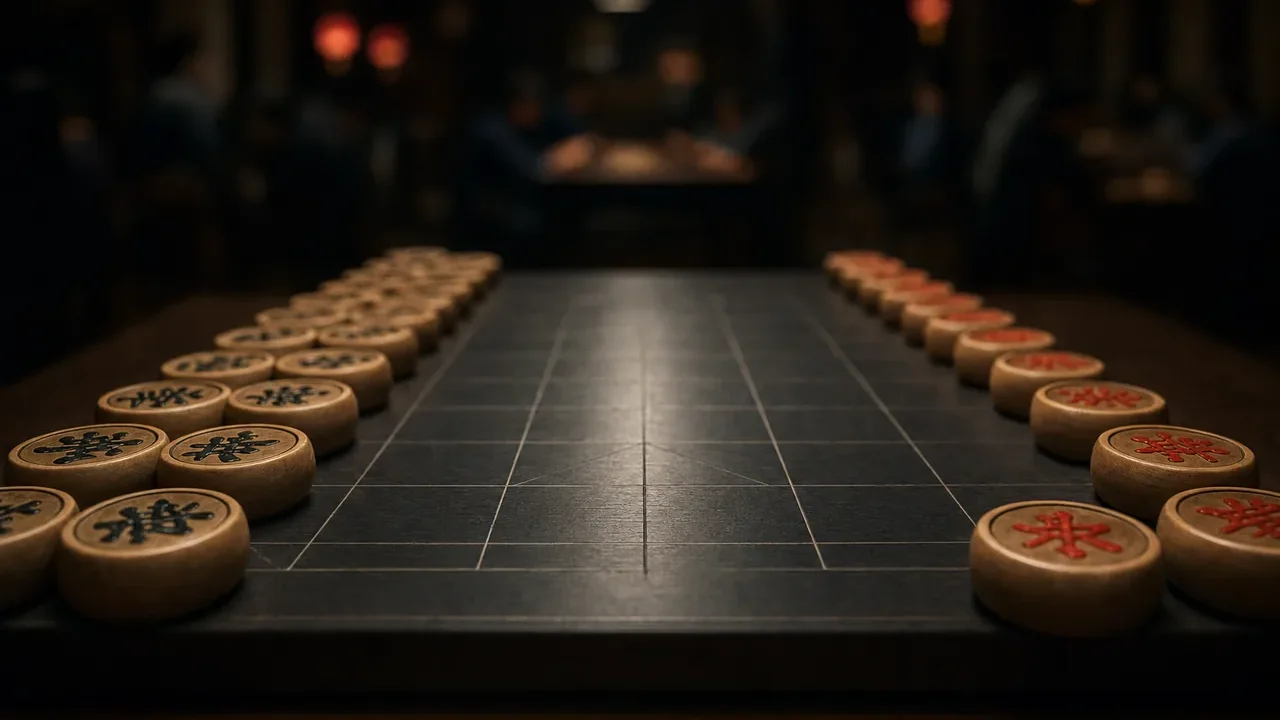
Xiangqi, known in English as Chinese chess, is one of the most played board games on earth: a fast, tactical cousin of Western chess in which cannons capture by leaping over other pieces, generals may never face each other across an open file, and the board itself – with its river and twin palaces – shapes every plan. By participation it rivals or exceeds any other strategy game, anchored by enormous player bases across China, Vietnam, and Chinese-speaking communities worldwide.
This page explains the full rules of xiangqi – board, pieces, movement, and the special rules that give the game its character – then moves on to strategy basics, history, and how it compares with international chess. You can apply everything immediately by playing xiangqi against the computer in your browser, free and without an account.
What Is Xiangqi? An Introduction to Chinese Chess
Xiangqi (象棋, pronounced roughly “shyahng-chee”) is a two-player game of the chess family played on the points – the line intersections – of a board nine files wide and ten ranks deep. Each player commands sixteen pieces: a general, two advisors, two elephants, two horses, two chariots, two cannons, and five soldiers. Red moves first, the players alternate, and the object is to checkmate or stalemate the enemy general.
The name is usually rendered “elephant game” or “figure game”. What strikes chess players first is the tempo: the major pieces – chariots and cannons – begin on open lines, so real threats appear within a handful of moves, and attacks on the confined general start early and rarely let up.
Xiangqi Rules at a Glance
| Element | Rule |
|---|---|
| Board | 9×10 points; pieces stand on intersections, not squares |
| Special zones | The river splits the board; each side has a 3×3 palace |
| Pieces per player | 16: general, 2 advisors, 2 elephants, 2 horses, 2 chariots, 2 cannons, 5 soldiers |
| First move | Red |
| Signature rules | Cannon needs a screen to capture; horse can be blocked; generals may never face each other on an open file |
| Check | As in chess: a threatened general must be made safe immediately |
| Winning | Checkmate or stalemate – a player with no legal move loses |
| Forbidden | Perpetual check and perpetual chase; the repeating side must vary |
The Board: River, Palaces, and Points
The xiangqi board is a grid of nine vertical files and ten horizontal ranks, and all play happens on the ninety intersections. Two features structure the geography. The river runs between the fifth and sixth ranks: elephants may never cross it, and soldiers get stronger once they do. The two palaces are the 3×3 zones marked with diagonal lines at the center of each back edge; the general and its advisors never leave them.
The Pieces and How They Move
General
The general moves one point orthogonally – never diagonally – and is confined to the nine points of its palace. The flying general rule adds a long-range twist: the two generals may never occupy the same file with no piece between them, so a general controls the full length of an open central file as if it were a chariot. Losing the general to checkmate, or having no legal move at all, loses the game.
Advisors
Advisors move one point diagonally and are likewise confined to the palace, giving each just five reachable points. They are pure bodyguards, screening the general against chariot and cannon attacks.
Elephants
Elephants move exactly two points diagonally and may never cross the river, restricting each to seven points on its own half. If the intermediate diagonal point is occupied by any piece, the move is blocked – “blocking the elephant’s eye”. Together with the advisors they form the defensive shell around the palace.
Horses
A horse moves one point orthogonally followed by one point diagonally outward – the same destination as a chess knight, but it is not a leaper. If the adjacent orthogonal point is occupied by any piece, that direction is blocked: the famous “hobbling the horse’s leg”. Horses start slow in the crowded opening and grow as lines clear.
Chariots
The chariot moves any number of points along an open rank or file, exactly like a chess rook, and is the strongest piece on the board. Developing the chariots to open files quickly is a first-order opening goal.
Cannons
The cannon is xiangqi’s signature piece. It moves like a chariot but captures only by jumping: there must be exactly one piece of either color – the screen – between the cannon and its target, and the cannon lands on the target’s point. With no screen, no capture; with two pieces in between, no capture. Cannons are devastating in the crowded opening and middlegame and fade as the board empties of screens.
Soldiers
Soldiers move and capture one point straight forward – they never capture diagonally like chess pawns. After crossing the river a soldier may also move one point sideways, but never backward, and there is no promotion: a soldier reaching the last rank can only move sideways thereafter. Soldiers that cross the river roughly double in value.
Check, Checkmate, and the Special Rules
Check works as in chess: a general under attack must be made safe immediately, by moving it, blocking the line, capturing the attacker, or – uniquely – breaking a cannon’s screen. Checkmate wins the game. Two further rules surprise newcomers:
- Stalemate loses. A player with no legal move loses, even if the general is not in check. Cornering a bare general is a standard winning technique, not a draw.
- Perpetual check and perpetual chase are forbidden. A player endlessly repeating checks, or endlessly attacking the same undefended piece, must vary or forfeit. This keeps worse positions from escaping into repetition draws and makes xiangqi endings notably decisive.
Xiangqi vs Chess: What Actually Differs
Players coming from international chess adapt quickly once they internalize a few differences. Pieces stand on points rather than squares, and there is no promotion to rebuild material, so attacks must succeed with the army you have. The general’s confinement to the palace makes mating patterns concrete and calculable, while the cannon – which has no chess counterpart – rewards a new kind of board vision built around screens. Openings explode faster: both sides can mount chariot-and-cannon pressure by move five. Is xiangqi harder than chess? Neither dominates; chess goes deeper in pawn structure and endgame theory, xiangqi is sharper earlier, and the games train complementary skills – a theme the journal returns to regularly across all the classic disciplines.
Xiangqi Strategy and Tactics
A few load-bearing principles take a new player a long way:
- Develop chariots early. The strongest piece wants open files; a chariot stuck in the corner is a wasted tempo engine.
- Respect the central cannon. Red’s most popular first move places a cannon on the central file, eyeing the soldier in front of the enemy general. Whole opening systems – screen horses, same-direction cannons – are organized around answering it.
- Mind your horse legs and elephant eyes. Blockable pieces invite tactics; a horse pinned behind its own soldier is a bystander.
- Keep the defensive shell coordinated. Two advisors and two elephants placed correctly blunt most single-piece attacks; trading them carelessly opens the palace.
- Count soldier value dynamically. A river-crossed soldier supported by a chariot is a siege weapon aimed at the palace.
- Aim for known winning endings. Classical endgame theory catalogs which material wins against which defense – for instance, a lone chariot generally beats advisors and elephants without help. The xiangqi strategy guide works through these fundamentals with diagrams.
How to Play Xiangqi Online
The quickest way to learn is with the rules enforced for you. The browser xiangqi board on this site plays full games against the computer – cannon screens, horse-leg blocks, palace confinement, and the flying general rule are all handled automatically, so illegal moves are simply impossible. It runs on desktop and mobile, free, with no account or download.
Pair playing with small daily doses of tactics: the daily puzzle rotates through the site’s disciplines, and the rest of the browser games collection – including draughts and go trainers – keeps the pattern-recognition muscles honest across game families.
The History of Xiangqi
Games called xiangqi appear in Chinese texts from antiquity, though the early references describe games clearly different from today’s. The modern game – the 9×10 board, the river, the cannon – is documented from the Song dynasty (960-1279), by which time xiangqi was already a popular pastime across social classes. Most historians place it within the wider chess family descending from the Indian chaturanga, transmitted and transformed along trade routes, while some scholars argue for an independent Chinese origin; the evidence remains genuinely contested. What is not contested is its reach: for centuries xiangqi has been played in parks, teahouses, and village squares across East and Southeast Asia, and organized national and world championships have run since the twentieth century under bodies such as the World Xiangqi Federation.
Xiangqi was one of the five disciplines contested at the World Mind Games, an international mind sports competition held annually in Beijing from 2011 to 2014, alongside chess, go, draughts, and bridge. The event placed elite xiangqi players on the same stage as their counterparts from the other classic strategy games; its editions, results, and medalists are documented in the World Mind Games history section.
Choosing a Xiangqi Set
Physical sets are inexpensive and highly portable. Standard pieces are flat wooden or plastic discs printed with the Chinese character of each piece – red and black traditionally use different characters for several pieces, which is cosmetic only. If you are buying a first set, look for discs around 3 to 4 cm across, a board with clearly marked palace diagonals and river, and – if you do not read the characters yet – a set that adds small icons or romanized labels. Many players simply learn the seven characters within a few games; they are part of the game’s charm.
Learn Xiangqi Step by Step
- Walk through the rules in the complete xiangqi rules guide, piece by piece with diagrams.
- Play enforced-rules games against the computer on the xiangqi board until the cannon and horse feel natural.
- Study the core plans in the strategy guide: central cannon systems, chariot activity, and basic winning endings.
- Keep tactics sharp with the daily puzzle, and explore how the skills transfer across the other disciplines.
Frequently Asked Questions
What is xiangqi?
Xiangqi, widely known as Chinese chess, is a two-player strategy board game in the same family as Western chess. Pieces stand on the intersections of a 9×10 grid divided by a river, each side has sixteen pieces led by a general confined to a palace, and the goal is to checkmate the enemy general. It is among the most played board games in the world.
How do you pronounce xiangqi?
Xiangqi is pronounced roughly “shyahng-chee” – the Mandarin syllables xiàng and qí. The x sounds like a soft “sh” and the q like “ch”. English speakers are usually understood with “shahng-chee” as well.
What is Chinese chess called in China?
In China the game is simply called xiangqi, written 象棋. The English label “Chinese chess” exists only to distinguish it from international chess; Chinese speakers call international chess guoji xiangqi, literally “international xiangqi”.
How do you play Chinese chess?
Red moves first, and players alternate moving one piece per turn on the intersections of the board. Chariots move like rooks, cannons capture by jumping a screen piece, horses move one step orthogonally then one diagonally, and soldiers push forward. You win by checkmating or stalemating the enemy general, which can never leave its three-by-three palace.
Is xiangqi harder than chess?
Neither game is objectively harder; they reward different skills. Xiangqi is more open and tactical from the first moves because chariots and cannons develop quickly, and the cramped palace makes mating attacks concrete. Chess has slower openings, denser pawn structures, and deeper endgame theory. Strong players of one game typically reach a respectable level in the other quickly.
Where was xiangqi invented?
Xiangqi developed in China. Strategy games with related names appear in early Chinese texts, and the modern board, pieces, and rules are documented from the Song dynasty (960-1279). Its deeper ancestry is debated among historians, with many tracing the wider chess family to ancient India and others arguing for independent Chinese roots.
What came first, xiangqi or chess?
Most historians derive both games from a common ancestor, usually identified with the Indian game chaturanga from around the sixth century CE, which spread east and west and adapted to local culture. Xiangqi in its modern form is documented from the Song dynasty, around the same era that recognizable European chess was taking shape – so the honest answer is that they are siblings rather than parent and child.
How does the cannon work in xiangqi?
The cannon moves exactly like a chariot – any distance along an open rank or file – but it captures differently: to take a piece it must jump over exactly one intervening piece of either color, called the screen, and land on the enemy piece beyond. With no screen it cannot capture, and it can never jump while making a non-capturing move.
Why can’t the two generals face each other?
The flying general rule states that the two generals may never stand on the same file with no pieces between them. Any move that would create that position is illegal. Practically, an open central file becomes a power line: a lone general controls it like a chariot, which is a common mating weapon in endgames.
What is the river in xiangqi?
The river is the horizontal band across the middle of the board between the two halves. It affects exactly two piece types: elephants can never cross it, which locks them into defense, and soldiers gain the ability to move sideways once they have crossed it. All other pieces ignore the river completely.
Can every piece cross the river?
All pieces except two may cross. Elephants are forbidden from crossing the river, and the general and its advisors are confined to the palace, so they never even reach it. Chariots, cannons, horses, and soldiers all operate on the whole board.
What happens when a soldier reaches the last rank?
Nothing is promoted – xiangqi has no equivalent of the chess pawn promotion. A soldier on the final rank can only shuffle sideways along it. Because of this, advancing soldiers carelessly devalues them, and keeping one or two connected soldiers near the enemy palace is worth more than racing one to the back rank.
Is stalemate a win in xiangqi?
Yes, and this is a major difference from chess. If a player has no legal move, that player loses, even if the general is not in check. Stalemating a defenseless opponent is therefore a normal winning method, and endgame technique is built around it.
What are the xiangqi pieces worth?
A common scale sets the chariot at 9, the cannon at 4.5, the horse at 4, advisors and elephants at 2 each, and a soldier at 1 before crossing the river and 2 after. Values shift with the position: horses gain strength in blocked endgames, while cannons are strongest in crowded middlegames where screens are plentiful.
Can you play xiangqi with a Western chess set?
Not directly: xiangqi has cannons and a 9×10 board of intersections, so a standard 8×8 chess set has neither the geometry nor enough piece types. You can improvise with labeled tokens on a printed board, but inexpensive xiangqi sets – or a free browser board – are easier ways to play with correct equipment.
Can I play xiangqi online against a computer?
Yes. The xiangqi board on this site runs directly in the browser and lets you play full games against the computer with all rules enforced, including the cannon screen, the blocked horse leg, and the flying general rule. No account or download is needed.
What do the characters on xiangqi pieces mean?
Each disc carries the Chinese name of its piece: general, advisor, elephant, horse, chariot, cannon, or soldier. Red and black use slightly different characters for several pieces – for example the red general is shuai and the black one is jiang – which is purely traditional and does not change how the pieces move.