Draughts Rules: How to Play English and International Draughts
Board setup, moves, forced captures and kings — the complete rules for English 8×8 and international 10×10 draughts, with a free board to practice against the computer.
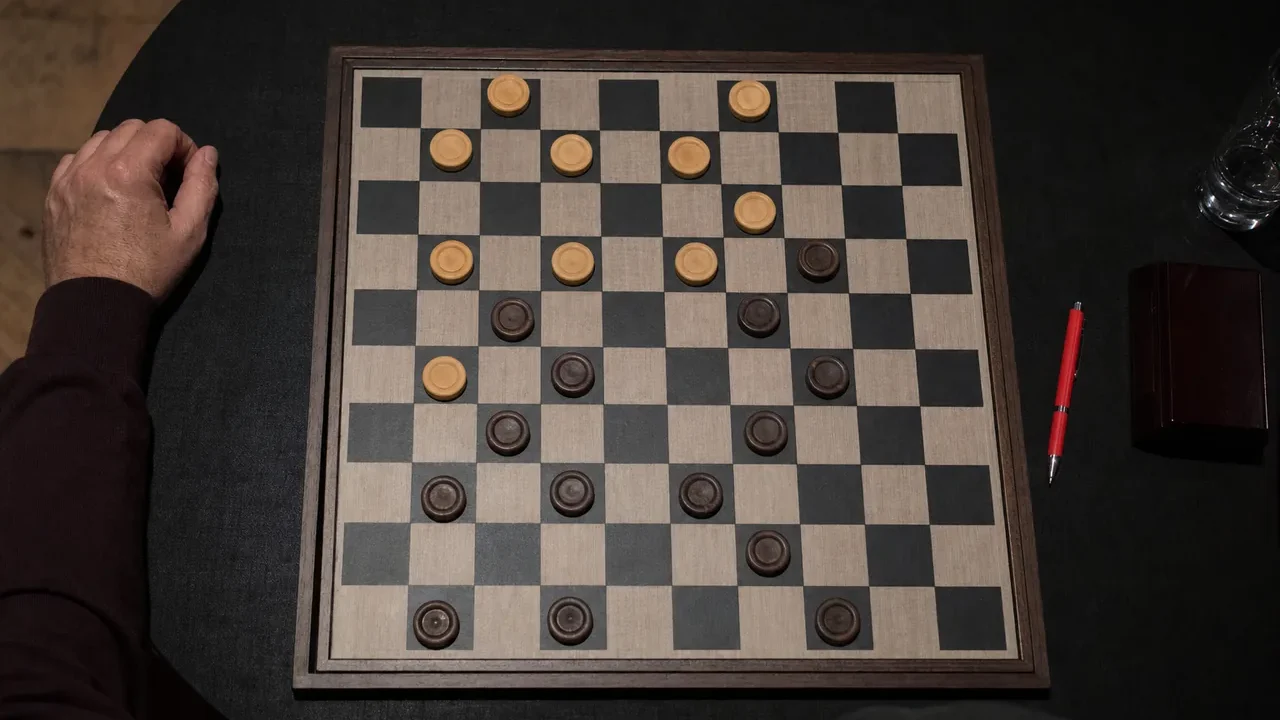
Draughts rules take about ten minutes to learn: two players move identical pieces diagonally across the dark squares of a checkered board, jump enemy pieces to capture them, and try to leave the opponent without a legal move. Behind that small rule set sits one of the deepest of all classic board games, played in organized competition for nearly two centuries and contested at international level in both its English 8×8 and international 10×10 forms.
This guide covers the complete rules of draughts, the differences between the English and international games, the core strategy ideas that decide most games, and where to practice. If you would rather learn by doing, you can play draughts against the computer right now in your browser, in either variant, with the forced-capture rules enforced for you.
What Is Draughts, and Is It the Same as Checkers?
Draughts is a two-player strategy game of diagonal movement and forced captures, played on the dark squares of a checkered board. The name covers a small family of games. English draughts, called checkers in North America, is played on the same 8×8 board as chess with 12 men per side. International draughts, the version governed by the World Draughts Federation (FMJD), uses a 10×10 board with 20 men per side and noticeably sharper capture rules.
So checkers and draughts are the same game whenever both words refer to the 8×8 version; they only diverge when “draughts” is used to mean the international 10×10 game. Everything below explains both, and the comparison table makes the differences explicit.
Draughts Rules at a Glance
| Rule | English draughts (checkers) | International draughts (FMJD) |
|---|---|---|
| Board | 8×8, 32 dark squares used | 10×10, 50 dark squares used |
| Men per player | 12 | 20 |
| First move | Darker side moves first | White moves first |
| Men move | One square diagonally forward | One square diagonally forward |
| Men capture | Forward only | Forward and backward |
| Capturing | Compulsory; free choice between sequences | Compulsory; must take the most pieces (majority rule) |
| Kings | Move and capture one square, any diagonal direction | Flying kings: any distance along a diagonal |
| Promotion | Turn ends when a man is crowned | Only if the move ends on the back row |
| Winning | Opponent has no legal move: all pieces captured or blocked | |
Board Setup and Pieces
Both versions are played entirely on the dark squares. Orient the board so that each player has a light square in the near right-hand corner; in the 8×8 game this puts the “double corner” of two connected dark squares on each player’s right. One side plays the lighter pieces, the other the darker, and the colors of the pieces matter only for telling the armies apart.
Setting up the 8×8 board
Each player places 12 men on the dark squares of the three rows nearest them, filling all twelve squares. The two central rows start empty. In printed notation the 32 playable squares are numbered 1 to 32, which is how games are recorded and how problem positions are published.
Setting up the 10×10 board
Each player places 20 men on the dark squares of the four rows nearest them. The two central rows start empty, and the 50 playable squares are numbered 1 to 50. The extra board space changes the character of the game: there is more room to maneuver, more material to calculate with, and far more capturing combinations.
How the Pieces Move
An uncrowned piece, called a man, moves one square diagonally forward to an adjacent empty dark square. “Forward” always means toward the opponent’s side of the board. Men never move backward in either version, and no piece may ever land on an occupied square or leave the dark squares.
Players alternate turns, moving exactly one piece per turn. If it is your turn and you have a legal move, you must make one; if you have no legal move, the game is over and you have lost. That losing condition matters more than newcomers expect, because blocked positions are a genuine winning method.
Capturing Rules: Jumps Are Compulsory
You capture by jumping: if an enemy piece stands on a diagonally adjacent square and the square directly beyond it is empty, your piece leaps over it to that empty square and the jumped piece is removed. If, after landing, the same piece can jump again, it must continue in the same turn – a multi-jump that can sweep up several pieces at once.
Capturing is compulsory in both games. If any of your pieces can jump, you must jump, even when it loses material. This single rule powers most draughts tactics: you deliberately offer one piece to force a capture that opens a two-for-one reply. The versions differ in one important detail:
- English draughts: men capture forward only, and when several capture sequences are available you may choose any of them, long or short.
- International draughts: men capture both forward and backward, and the majority rule applies – you must play the sequence that captures the largest number of pieces. A king and a man count equally for this count. Captured pieces are removed only after the whole sequence is finished, and no piece may be jumped twice within one sequence.
Kings: Crowning and King Movement
When a man ends its move on the far row – the king row or crownhead – it is crowned and becomes a king, traditionally marked by stacking a second piece on top. Kings move and capture diagonally in all four directions, which transforms the endgame.
In English draughts a king still moves just one square at a time, and crowning ends the turn immediately even if a further jump would be possible. In international draughts kings are flying kings: a king slides any number of empty squares along a diagonal, captures an enemy piece anywhere on that diagonal provided at least one empty square lies directly beyond it, may land on any of those empty squares, and may turn onto a new diagonal between jumps of a multi-capture. One more subtlety of the 10×10 game: a man that merely passes over the back row in the middle of a capture sequence and keeps jumping is not crowned – promotion happens only when the move ends there.
How to Win, Lose, or Draw
You win when your opponent cannot move on their turn, either because every piece has been captured or because the remaining pieces are completely blocked. There is no equivalent of checkmate or a king that must be protected; the whole army is the target.
Draws happen when neither side can force progress, most often in endings with a few kings each. Players may agree to a draw, and tournament rules end the game after repeated positions or long sequences without a capture or promotion. English draughts is in fact weakly solved – the Chinook research project proved in 2007 that perfect play by both sides leads to a draw – which is why serious 8×8 tournaments often use opening ballots to force varied early play.
Common Rule Variations
Beyond the two main codes, national variants tweak the same ingredients. Brazilian draughts applies international rules on an 8×8 board. Russian draughts lets men capture backward and promotes a man the moment it touches the king row, even mid-sequence. Italian draughts forbids men from capturing kings. Turkish draughts abandons the diagonals entirely: pieces move straight forward and sideways on all 64 squares.
Casual house rules also survive, the most famous being huffing – removing a piece that failed to make a compulsory capture. Modern rule sets have dropped it; the move is simply retracted. When you sit down with a new opponent, two questions settle everything: which board, and which capture rules.
Draughts Strategy Fundamentals
Strong draughts play starts with a handful of principles that follow directly from the forced-capture rule:
- Count captures before you move. Every move you make can create a compulsory jump for either side. The two-for-one shot – offering one piece to win two – is the bread and butter of draughts tactics.
- Fight for the center. Central squares give each piece the maximum number of diagonals; edge pieces cover half as much ground.
- Keep your back row intact early. Your king row is the opponent’s promotion target. Holding back two of its defenders delays enemy kings, though clinging to the back row too long costs mobility.
- Advance in formation. Pieces defending each other along diagonals – the phalanx – deny safe landing squares. Lone advanced men become targets of multi-jumps.
- Trade when ahead. Each exchange increases a material edge proportionally. Up one piece, trading toward a king ending is usually the cleanest win.
- Race for the first king. Especially in the 10×10 game, the first flying king dominates open diagonals and often decides the endgame on its own.
The dedicated draughts strategy guide develops each of these themes with worked positions, from basic shots to endgame opposition.
How to Play Draughts Online
The fastest way to internalize the rules is to play with them enforced. The browser draughts board on this site lets you play both English 8×8 and international 10×10 draughts against the computer – no account, no download. Forced captures, multi-jumps, majority-rule sequences, and flying kings are all handled by the engine, so you can concentrate on finding the best move instead of policing the rules.
A practical training loop: play a few 8×8 games until forced captures feel natural, switch to 10×10 to experience backward captures and flying kings, then test your tactical eye on the daily puzzle. The full browser games collection also covers chess, xiangqi, and go training boards if you want to rotate disciplines, and regular pattern-recognition work of this kind is exactly the sort of training discussed in the brain training guide.
History and Culture
Draughts descends from alquerque, an ancient Mediterranean alignment-and-capture game. The decisive step came in medieval France, when alquerque pieces were transferred onto the chessboard and the promoted piece borrowed its movement from the chess queen of the era. The compulsory capture arrived in the sixteenth century and gave the game its tactical bite, and the 10×10 international game became established in France and the Netherlands during the eighteenth century. Organized championship play dates to the nineteenth century, and today the FMJD oversees world title cycles in international draughts while national federations maintain the 8×8 tradition.
Draughts was one of the five disciplines contested at the World Mind Games, an international competition for mind sports held annually in Beijing from 2011 to 2014, alongside chess, go, xiangqi, and bridge. The event brought invited world-class draughts players into a shared arena with the other classic strategy games, and its results and medalists are documented in the World Mind Games history section.
Learn Draughts Step by Step
A sensible path from first game to confident club-level play:
- Master the mechanics with the complete rules walkthrough, which covers setup, jumps, and crowning with diagrams.
- Play enforced-rules games on the draughts board until you stop being surprised by forced captures.
- Study the core ideas in the strategy guide: shots, formations, tempo, and endgame technique.
- Solve daily. A few minutes on the daily puzzle builds the pattern library that lets you spot combinations at a glance.
- Broaden the lens. Comparing draughts thinking with go or chess sharpens both; the journal publishes pieces on exactly these crossovers, and the disciplines overview maps the whole family.
Frequently Asked Questions
How do you play draughts?
Each player starts with a set of identical pieces on the dark squares and moves one piece per turn diagonally forward. You capture by jumping over an adjacent enemy piece onto the empty square beyond, captures are compulsory, and a piece that reaches the far row becomes a king. You win by leaving your opponent with no legal move. The step-by-step rules guide walks through a full game.
What are the basic rules of draughts?
Pieces stay on the dark squares, men move one square diagonally forward, and jumping an enemy piece captures it. If a capture is available you must take it, multi-jumps must be completed in the same turn, and reaching the far row promotes a man to a king, which can also move backward.
How do you set up a draughts board?
Place the board so each player has a light square in the near right-hand corner. In English draughts each player puts 12 men on the dark squares of the three rows nearest them; in international draughts each player puts 20 men on the dark squares of the four nearest rows. The two middle rows start empty.
How many pieces are in draughts?
English draughts uses 24 pieces in total, 12 per player, on an 8×8 board. International draughts uses 40 pieces, 20 per player, on a 10×10 board. In both games only the dark squares are used, so the piece count always equals the playable squares of the first three or four rows.
Can you move backwards in draughts?
Ordinary men never move backward in any version. In English draughts men also capture only forward, while in international (10×10) draughts men may capture backward even though they move forward. Kings can move and capture in both directions in every version.
Do you have to take in draughts?
Yes. Capturing is compulsory in both English and international draughts: if one of your pieces can jump, you must jump, and a multi-jump must be played to the end. In international draughts you must additionally choose the sequence that captures the most pieces, known as the majority rule.
Is checkers the same as draughts?
Checkers is simply the American name for English draughts; the rules are identical. Confusion arises because “draughts” can also refer to the international 10×10 game, which uses a bigger board, backward captures for men, and long-range flying kings.
How do you play draughts under UK rules?
UK players normally play English draughts: an 8×8 board, 12 men each, the darker side moving first, forward-only captures for men, and short-range kings. Compulsory capture applies, but when several capture sequences exist you may choose freely between them; there is no majority rule.
What happens when a piece reaches the other side of the board?
It is crowned and becomes a king, traditionally marked by stacking a second piece on top. In English draughts the turn ends immediately on promotion. In international draughts a man is only promoted if its move actually ends on the back row; passing through it mid-capture does not count.
Can a king be captured in draughts?
Yes. A king is jumped and removed exactly like an ordinary man; it has no special immunity. Kings are stronger only because they can move and capture backward, and in international draughts because they travel any number of squares along a diagonal.
Who moves first in draughts?
In English draughts the player with the darker pieces moves first. In international draughts it is the opposite: White always makes the first move. In casual play, agree which convention you are using before the game and alternate colors between games.
Can you jump your own pieces in draughts?
No. You may only jump enemy pieces, and the landing square immediately beyond the jumped piece must be empty. Your own pieces block movement, which is why an over-crowded position can suddenly leave you without a safe move.
How does a game of draughts end in a draw?
A draw occurs when neither side can force a win, most often in king-versus-king endings. Players can agree to a draw, and tournament rules declare one after repeated positions or a set number of moves without progress. Perfect play in English draughts has been proven to end in a draw.
What is huffing in draughts?
Huffing was an old penalty rule: if a player overlooked a compulsory capture, the opponent could remove the offending piece from the board. Modern rule sets have abolished it, and an illegal or overlooked move is simply taken back and replayed correctly.
Is draughts a solved game?
English draughts was weakly solved in 2007 by the team behind the Chinook computer program: with perfect play from both sides the game is a draw. International 10×10 draughts is far larger and remains unsolved, which is one reason it stays the main tournament version.
How long does a game of draughts take?
A casual game of English draughts usually takes 10 to 30 minutes. International draughts games run longer because of the bigger board and the majority rule. Tournament play uses clocks, with classical, rapid, and blitz time controls just as in chess.
Can you play draughts online for free?
Yes. The draughts board on this site runs in the browser with no account or download, and lets you play both English 8×8 and international 10×10 rules against the computer, with forced captures handled automatically.